


UAE SWAT Challenge 2027 Brings the World’s Elite Tactical Teams Back to Dubai
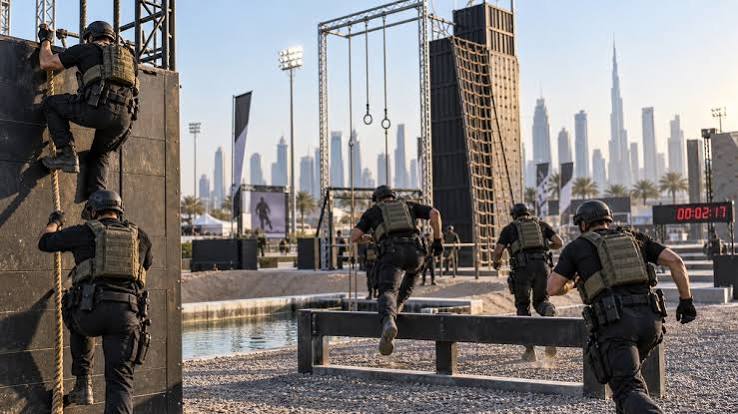
Dubai will host one of the world’s largest specialised tactical-team competitions from 23 to 27 January 2027 when the UAE SWAT Challenge returns for its eighth edition at Training City in Al Ruwayyah.
Organised by Dubai Police, the five-day competition brings together SWAT units, rapid-intervention teams and other specialised police teams from around the world.
Unlike conventional spectator sports, the competitors are professional tactical officers.
The events test physical conditioning, precision, technical ability, teamwork and operational decision-making through demanding scenarios.
The 2027 programme contains five major challenges: Assault Event, Hostage Rescue, Officer Rescue, Tower Assault and Obstacle Course.
Points are awarded throughout the competition, with the team achieving the highest cumulative total becoming the overall champion.
A Sporting Competition With Operational Roots
The UAE SWAT Challenge sits in an unusual category.
It is clearly competitive.
Teams train for performance.
Scores and rankings matter.
Spectators attend.
There is an overall champion.
Yet the skills being tested originate from real professional requirements rather than conventional sport.
Tactical officers need physical endurance.
They need strength.
They need accuracy.
They need to communicate effectively under pressure.
The competition turns those professional abilities into measurable events.
This makes it fascinating even for spectators who know little about tactical policing.
Five Days, Five Different Tests
Each competition day focuses on a different challenge.
That format prevents a team from relying on one strength.
A unit may be exceptionally fast but lose time because of poor coordination.
Another team may perform technical tasks perfectly but struggle physically.
The overall champion needs balance.
This is similar to multi-event sports where success depends on consistency rather than dominating a single discipline.
A poor result on one day can affect the entire week.
Every point matters.
The Assault Event Tests Speed and Precision
Assault-style challenges require teams to move quickly while maintaining technical control.
This balance is difficult.
Physical exertion raises heart rate.
Fine motor control becomes harder.
Decision-making can deteriorate.
Elite tactical teams train specifically to maintain accuracy under stress.
The competition makes that ability visible.
Going fast is not enough.
Going slowly and perfectly is not enough either.
Teams need an efficient combination.
Hostage Rescue Places Teamwork at the Centre
Rescue scenarios require coordination.
Participants cannot operate as isolated individuals.
Every team member has a role.
Communication needs to be immediate.
Movement has to be organised.
One person making a mistake can affect everyone else.
That is why tactical competitions place so much emphasis on teamwork.
Individual fitness helps.
Collective execution wins.
Officer Rescue Adds Physical Demands
Rescue challenges can involve carrying or moving significant loads while completing a timed course.
These tasks test functional strength rather than gym strength in isolation.
Being able to lift a barbell is useful.
Moving weight while running, navigating obstacles and coordinating with teammates creates a different challenge.
Grip strength, leg endurance and cardiovascular capacity all become important.
Fatigue accumulates quickly.
Tower Assault Creates a Vertical Challenge
The Tower Assault event adds elevation and climbing demands.
Moving vertically under time pressure places enormous demands on the legs and lungs.
Stairs or climbing tasks can raise heart rate rapidly.
Teams then need to maintain technical performance despite that fatigue.
This illustrates why tactical athletes require broad physical conditioning.
They cannot specialise only in running or strength.
Operational environments demand both.
The Obstacle Course Provides a Dramatic Finale
Obstacle courses are among the easiest events for spectators to understand.
The objective is visible.
Teams need to move through barriers as quickly and cleanly as possible.
Speed becomes obvious.
Mistakes become obvious.
Athletic differences become obvious.
Yet even here, teamwork matters.
The fastest individual cannot simply abandon the group.
Performance is collective.
Preparation Begins a Week Before the Main Competition
The official schedule includes practice and event-walkthrough sessions from 16 to 22 January before the main competition begins on 23 January.
This gives international teams time to familiarise themselves with the facility and competition environment.
Preparation can include equipment checks, course understanding and technical practice.
These days matter because small misunderstandings can become costly once timing begins.
Teams Travel From Around the World
The UAE SWAT Challenge has developed into a genuinely international event.
Previous editions have achieved Guinness World Records recognition for the number of participating countries.
The 2027 competition is again open to specialised units worldwide.
Different countries bring different training systems.
That makes the challenge useful beyond rankings.
Teams can observe how other units approach similar problems.
Professional knowledge is exchanged.
Participants compare preparation standards.
The event becomes both competition and international meeting point.
The Venue Is Built for Tactical Training
The Dubai SWAT Training Facility at Al Ruwayyah contains specialised environments designed around the event.
These include shooting ranges, a tactical house, tower, obstacle course and other purpose-built zones.
That infrastructure separates the UAE SWAT Challenge from an improvised competition.
The facility allows organisers to create repeatable scenarios where teams can be evaluated consistently.
Spectator and media areas also support the public-event side of the competition.
The Event Is Open to Spectators
One of the most interesting features is public access.
People can attend and support the competing teams.
That provides a rare opportunity to observe specialised units in a sporting context.
The environment is controlled.
The challenges are structured.
Spectators can focus on physical and technical performance rather than real emergency situations.
For children and young people interested in policing, security or physical fitness careers, the competition can be particularly interesting.
Functional Fitness Becomes Extremely Visible
Modern tactical officers train more like athletes than many people realise.
Running ability matters.
Strength matters.
Mobility matters.
Grip strength matters.
The ability to recover quickly between intense efforts matters.
This is why many tactical training programmes use functional exercises that resemble movements seen in hybrid fitness competitions.
The difference is purpose.
A recreational athlete trains these abilities for sport.
A tactical officer needs them for professional readiness.
Pressure Changes Performance
One of the most valuable aspects of competition is the introduction of pressure.
Teams may perform a skill perfectly during training.
Doing the same thing against a clock, in front of spectators and while competing against international units creates a different psychological environment.
Pressure exposes habits.
Strong teams remain organised.
Communication stays clear.
Routines remain disciplined.
Less prepared groups begin rushing.
That is why competition can provide useful feedback even for highly trained professionals.
Dubai Has Built a Unique International Event
The UAE SWAT Challenge does not have many direct equivalents on the global sports calendar.
It combines tactical professionalism, fitness, competition and public spectacle.
That uniqueness has helped it grow quickly.
Dubai also has the infrastructure and international accessibility required to bring large numbers of specialised units together.
Teams can travel relatively easily from Europe, Asia, Africa, the Middle East and beyond.
The city becomes a neutral meeting point.
Five Days Will Decide the Champion
No team can win the 2027 title through one exceptional performance.
The competition requires consistency across all five challenges.
Speed.
Accuracy.
Strength.
Endurance.
Technical skill.
Communication.
Teamwork.
All contribute.
From 23 to 27 January, Training City will place those qualities under pressure.
For spectators, it offers something completely different from a conventional January sports event.
For the competitors, it is an international benchmark against some of the best tactical teams in the world.
And for Dubai, the eighth UAE SWAT Challenge strengthens another distinctive position on the global sporting calendar.