


Urbanator Christmas Special 2026 Brings Indoor Obstacle Racing to Dubai World Trade Centre
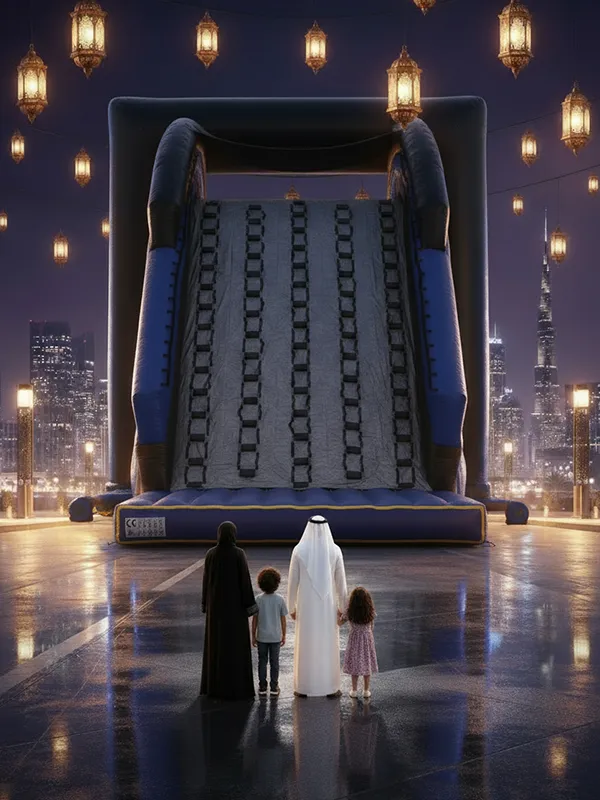
Dubai’s fitness calendar will close the year with a very different kind of challenge on 26 December 2026 when the Urbanator Christmas Special transforms Dubai World Trade Centre into an indoor obstacle-racing arena.
The event, organised by Arabian Warrior, combines short running loops with inflatable and urban-style obstacles in a spectator-friendly format designed for adults, teenagers, children, families and teams.
The main Urban Adult Course covers up to 5km and includes as many as 15 obstacles, while younger participants aged 10 to 13 can enter the Urban Junior course, which runs for up to 1km with as many as 10 obstacles.
The first heat begins at 8am.
Unlike a conventional road race, the objective is not simply to run from the starting line to the finish as quickly as possible.
Athletes need to climb, crawl, balance, move over barriers and adapt to whatever appears next.
That combination makes the Christmas Special one of Dubai’s most unusual end-of-year fitness events.
Indoor Obstacle Racing Changes the Usual Formula
Most obstacle-course races take place outdoors.
Mud, natural terrain and long running sections are often central to the experience.
Urbanator takes a different approach.
Dubai World Trade Centre becomes the race environment.
Instead of desert terrain or muddy fields, competitors face artificial obstacles created specifically for a compact indoor course.
That produces several advantages.
Weather becomes predictable.
Spectators remain close to the action.
The course can include obstacles that would be difficult to transport or maintain across a long outdoor route.
The result is closer to a fitness festival than a traditional endurance race.
Up to 5KM Does Not Mean Easy
Five kilometres sounds manageable to most regular runners.
Obstacle racing changes the calculation.
A normal 5K allows athletes to settle into a rhythm.
Run.
Maintain pace.
Reach the finish.
Urbanator repeatedly interrupts that rhythm.
A competitor may run for a short section and immediately need to climb.
The next obstacle may require crawling.
Another could demand balance or upper-body strength.
Heart rate remains elevated while different muscle groups are repeatedly called into action.
A runner capable of completing five kilometres comfortably may therefore discover that obstacle racing creates a completely different type of fatigue.
Fifteen Obstacles Demand Balanced Fitness
The adult course can feature up to 15 obstacles.
That means athletes cannot rely on one physical strength.
Strong runners may move quickly between stations but lose time on obstacles requiring grip or pulling strength.
Powerful gym athletes may dominate strength-based sections while struggling during repeated running intervals.
The most successful competitors are generally those without a major weakness.
They can run reasonably well.
They can climb.
They can carry their own body weight.
They have enough mobility to move under and around obstacles.
They remain coordinated after fatigue begins.
This is what makes obstacle racing a useful test of general fitness.
Grip Strength Often Becomes the Surprise
Many people train legs, chest and shoulders regularly but rarely think about grip endurance.
Obstacle courses expose that weakness quickly.
Hanging from bars, gripping structures and pulling the body upward can fatigue the hands and forearms rapidly.
Once grip begins to disappear, even relatively simple obstacles become difficult.
Preparation does not need to be complicated.
Dead hangs from a pull-up bar are useful.
Farmer carries help build grip while also challenging posture and core stability.
Pull-ups and assisted pull-ups improve upper-body pulling strength.
The key is endurance.
Competitors need their hands to continue working after several previous obstacles.
Running Fitness Still Matters
Because obstacles attract most of the attention, some competitors may neglect running preparation.
That is a mistake.
The adult course still covers up to five kilometres.
A participant with weak cardiovascular fitness will arrive at each obstacle already exhausted.
That makes technical movement more difficult.
Even basic running preparation can help significantly.
Two or three sessions per week are enough for many recreational athletes.
One can be an easy continuous run.
Another can use short intervals.
A third can combine running with bodyweight exercises.
The goal is not necessarily to become a specialist runner.
It is to develop enough aerobic capacity that the running sections do not destroy the rest of the race.
Combination Training Is Ideal
The best way to prepare for obstacle racing is often to combine movement types within the same workout.
For example:
Run for five minutes.
Complete push-ups or burpees.
Run again.
Perform a carry.
Add lunges.
Hang from a bar.
Return to running.
This teaches the body to change tasks without fully recovering.
That is much closer to the demands of Urbanator than completing an isolated gym workout and a completely separate run on another day.
The exact event obstacles do not need to be recreated.
Athletes simply need to become comfortable moving under fatigue.
The Christmas Special Adds a Festive Twist
The 26 December date gives the event a distinctive identity.
The organisers describe it as a Christmas-themed end-of-year challenge designed around fun as much as competition.
That means participants should expect a lighter atmosphere than a major championship obstacle race.
Friends can enter together.
Families can attend.
Festive clothing and seasonal themes can become part of the experience.
For people who have spent December surrounded by large meals, celebrations and disrupted training routines, the event also provides a reason to become active again immediately after Christmas Day.
Do Not Confuse Fun With Easy
A festive atmosphere does not remove the physical challenge.
Obstacle races become difficult because they require repeated transitions between physical demands.
One moment the athlete is running.
The next requires strength.
Then coordination.
Then running again.
There may be little time for complete recovery.
People entering primarily for fun should still arrive with basic fitness.
That makes the experience significantly more enjoyable.
The Indoor Venue Removes Dubai’s Weather Problem
Late December already offers excellent outdoor conditions in Dubai, but an indoor venue still provides advantages.
Temperature can be controlled.
Wind does not influence obstacles.
Rain cannot disrupt the event.
Spectators remain comfortable.
Participants know exactly what environment to expect.
This predictability allows organisers to create technical obstacles without worrying about changing outdoor conditions.
It also makes the event highly accessible for families who want to watch several heats.
Spectators Can Follow the Action More Easily
One challenge with outdoor obstacle racing is that spectators often see only the start, finish and a small number of obstacles.
Competitors disappear across a large course.
An indoor race changes that.
The compact format allows spectators to remain much closer to multiple sections of the action.
Friends and family can see participants tackle obstacles rather than waiting long periods without knowing where they are.
This makes Urbanator particularly suitable for younger spectators.
The event becomes something they can follow rather than simply waiting at the finish line.
The Junior Course Gives Children Their Own Challenge
The Urban Junior course covers up to 1km and includes as many as 10 obstacles.
It is intended for children aged 10 to 13.
This is a smart format because children naturally enjoy obstacle-style movement.
Climbing.
Crawling.
Jumping.
Balancing.
These activities feel more like play than structured exercise.
That can help younger participants build confidence and coordination without thinking of fitness as a chore.
The distance is also short enough to keep the focus on fun rather than endurance.
Teenagers Can Progress to the Adult Course
Participants aged 14 and above can enter the adult event.
Competitors between 10 and 17 require parental consent and must be accompanied by a parent or guardian at the event.
For teenagers, the adult category provides an opportunity to test themselves across a more demanding course.
Parents should still make realistic decisions about readiness.
A 14-year-old athlete with regular sports experience may be comfortable with the challenge.
Someone with very little activity background may need more preparation.
Age eligibility does not automatically mean every participant has identical fitness.
Technique Often Beats Raw Strength
Obstacle racing rewards people who solve movement problems efficiently.
An athlete may be physically strong enough to force their way through an obstacle.
A technically skilled competitor may complete the same challenge using far less energy.
Foot position matters.
Body angle matters.
Using momentum correctly matters.
The legs can often help reduce upper-body workload.
This becomes important because wasted energy accumulates across 15 obstacles.
The smartest athlete is not necessarily the one who attacks everything with maximum force.
Mobility Can Make Obstacles Easier
People often focus on strength and endurance while forgetting mobility.
Restricted hips can make crawling awkward.
Poor shoulder mobility can make overhead movement uncomfortable.
Limited ankle range can affect balance and landing.
Basic mobility work can therefore support obstacle performance.
This does not require extreme flexibility.
Athletes simply need enough movement range to position the body effectively.
Dynamic mobility before training sessions can help.
Shoes Should Prioritise Control
Because the event takes place indoors, footwear requirements differ from muddy outdoor obstacle races.
Aggressive trail shoes designed for deep mud may not be necessary.
Participants should choose shoes that feel stable, fit securely and allow quick direction changes.
Whatever they choose should already have been tested.
Race day is never the best time to discover that new shoes create blisters.
Clothing Should Allow Movement
Obstacle racing requires more movement variety than road running.
Clothing needs to allow climbing, crawling and bending.
Extremely loose garments may catch on equipment.
Heavy clothing can become uncomfortable during repeated high-intensity movement.
Light, flexible sportswear is usually the practical option.
The Christmas theme can still be incorporated without sacrificing mobility.
A festive hat may be amusing.
A full costume that prevents climbing may not be.
Teams Can Make the Experience Better
Although obstacle racing can be competitive, many participants enjoy it more as a group challenge.
Friends can motivate one another.
Coworkers can enter together.
Families can compete in different categories.
Nobody needs to be an elite athlete.
The event becomes a shared story.
Which obstacle caused the most trouble?
Who moved fastest?
Who almost fell?
Who surprised everyone?
Those memories often matter more than final timing.
Obstacle Racing Can Reveal Training Weaknesses
One advantage of an event like Urbanator is that it exposes gaps in general fitness.
A runner may discover weak upper-body strength.
A bodybuilder may discover poor cardiovascular conditioning.
Someone with strength and endurance may struggle with coordination.
This information can make future training more balanced.
Competition becomes a diagnostic tool.
The result is not simply a finish time.
It shows what the athlete needs to improve.
December 26 Offers an Unusual End-of-Year Target
Many people allow training to disappear during the final weeks of December.
The Urbanator Christmas Special provides a reason not to.
Participants have a concrete event immediately after Christmas Day.
That can encourage consistent training through December.
It also creates a fun transition toward New Year fitness goals.
Instead of waiting until January 1 to become active, participants finish the year already moving.
A Fitting Finale to Dubai’s 2026 Fitness Calendar
Dubai will have hosted an extraordinary variety of sporting events by the time Urbanator arrives.
International basketball.
Triathlon.
Rugby.
Running.
Cycling.
Sailing.
Bodybuilding.
Golf.
Obstacle racing provides one final variation.
The Christmas Special does not need to be the longest or most extreme challenge of the year.
Its appeal lies in being different.
Up to five kilometres.
As many as 15 obstacles.
An indoor course.
A festive atmosphere.
Junior events.
Friends and families watching from nearby.
On 26 December, Dubai World Trade Centre will temporarily stop looking like an exhibition venue and become a giant urban playground for athletes.
For anyone looking to finish 2026 with something more memorable than another treadmill session, Urbanator offers a fitting final challenge.