


Dubai Marathon 2027 Returns on January 17 With Marathon, 10K and 4K Races
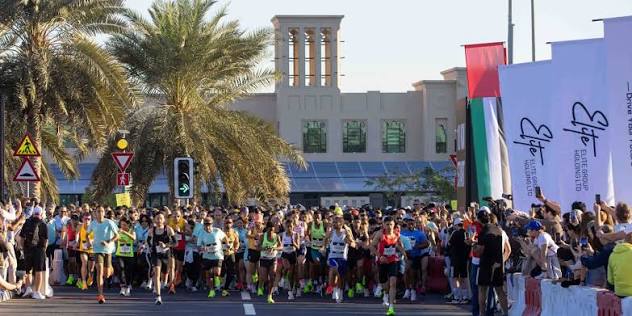
Dubai Marathon will return on 17 January 2027 for its 26th edition, bringing elite athletes, experienced amateur runners, first-time racers and families together for one of the Middle East’s most established road-running events.
The 2027 programme will once again offer three distances: the full 42.195km marathon, a 10km road race and a 4km fun run.
That combination gives Dubai Marathon an unusually broad appeal.
Elite runners can chase fast times over the classic marathon distance.
Serious recreational athletes can target personal bests.
Thousands of runners can enter the 10km without taking on the enormous training commitment required for a marathon.
Families and beginners can experience race day through the 4km event.
For Dubai’s running community, 17 January is therefore much more than a competition for professional marathoners.
It is one of the city’s biggest annual celebrations of running.
The 26th Edition Continues a Long Dubai Tradition
Dubai Marathon has developed over more than two decades into one of the region’s most recognisable endurance events.
According to the organisers, more than 400,000 runners have participated during the race’s history.
The 2026 silver-anniversary edition attracted 19,338 participants from 151 countries, with international runners making up a significant part of the field.
Those numbers demonstrate how far the event has expanded beyond the local running community.
Dubai Marathon is now a sports-tourism event as well as a city race.
Some runners build an entire trip around it.
Others living in the UAE treat January as the conclusion of months of winter training.
The mix of residents and international visitors creates an atmosphere that feels very different from a small local race.
Why Dubai Has a Reputation for Fast Marathon Running
Dubai has developed a reputation as an attractive destination for athletes chasing fast marathon times.
The course is relatively flat, removing the long climbs that can make other city marathons especially difficult.
That does not make 42.195km easy.
Nothing makes a marathon easy.
But a flatter route allows athletes to settle into a consistent rhythm and focus on maintaining pace.
This has contributed to a history of strong elite performances.
At the 2026 edition, Ethiopian debutant Nibret Melak won the men’s race in 2:04:00, while fellow Ethiopian Anchinalu Dessie produced a personal best of 2:18:31 in the women’s event.
Performances at that level reinforce Dubai’s reputation internationally.
For recreational runners, the same course characteristics create opportunities to pursue personal bests.
The Marathon Starts Before Sunrise
Race morning begins early.
Elite marathon runners are scheduled to start at 5:45am, followed by the mass marathon field at 6:30am.
The early timing is important.
Even during January, Dubai temperatures rise after sunrise.
Starting early gives marathon runners the opportunity to complete a significant portion of the race during the coolest part of the morning.
Participants should therefore prepare for a very early wake-up.
Breakfast, transport and race preparation all need to be planned carefully.
A marathon morning is not the time to improvise.
Runners should know exactly what they will eat, what they will wear and how they will reach the start area.
A Route Through One of Dubai’s Most Recognisable Areas
The marathon starts around Umm Suqeim and Al Sufouh, with the route taking runners through areas near some of Dubai’s best-known landmarks.
The Burj Al Arab becomes one of the defining visual features of the course.
For visiting runners, this creates an unmistakably Dubai race experience.
Urban marathons are attractive partly because participants see a city in a way tourists normally cannot.
Roads are controlled for runners.
Familiar areas look completely different without normal traffic.
Thousands of people move through spaces usually dominated by cars.
For residents, running past landmarks seen regularly from a vehicle can feel surprisingly different on foot.
The 10K Creates a More Accessible Challenge
Not everybody wants to run a marathon.
That is why the 10km road race is so important to the event.
The 10K begins at 8am and is open to runners aged 15 and above.
Ten kilometres is long enough to provide a serious sporting challenge without requiring months of marathon-level preparation.
For beginners, completing a first 10K can be a major achievement.
For experienced runners, the distance becomes a speed challenge.
A serious 10K race can be extremely demanding because athletes maintain a much higher intensity than during a marathon.
The distance is also useful for runners who eventually want to progress toward a half marathon or marathon.
It provides experience with race-day pacing, crowds and organised road running.
The 4K Fun Run Opens the Event to Everyone
The 4km Fun Run provides the most accessible entry point.
It is open to participants of all ages and starts later in the morning.
Families can participate together.
Children can experience a large organised running event.
People who have never entered a race can join without worrying about marathon training.
This matters because mass-participation sport should not cater only to already-fit people.
Shorter distances can be the gateway that introduces someone to regular physical activity.
A person who completes 4km in January might enter a 5km event later.
From there, 10km becomes possible.
Progress often begins with a distance that feels achievable.
Marathon Training Requires Patience
Anyone entering the full marathon should already be thinking seriously about preparation.
The official Dubai Marathon training material begins months before race day for good reason.
The body needs time to adapt to long-distance running.
Trying to compress marathon preparation into a few weeks dramatically increases the risk of injury or a difficult race experience.
A typical programme includes easy runs, longer endurance sessions and some faster training.
The long run becomes increasingly important as race day approaches.
It teaches the body to remain active for extended periods.
It also builds confidence.
There is a major psychological difference between standing at a marathon start after months of consistent training and arriving unsure whether your body can tolerate the distance.
Pacing Can Decide the Entire Race
One of the most common marathon mistakes occurs during the opening kilometres.
The runner feels excellent.
The crowd creates energy.
Weeks of reduced training have left the legs fresh.
A planned pace suddenly feels too easy.
The temptation is to run faster.
The consequences often appear much later.
A marathon punishes early overconfidence.
Someone who runs the first half only slightly too quickly can lose huge amounts of time during the final 10 kilometres.
The smartest strategy is usually to respect the planned pace from the beginning.
The race does not truly reveal itself during the first five kilometres.
For many runners, the real challenge begins after 30km.
Nutrition Is Part of Marathon Training
Marathon performance also depends on more than running ability.
The body needs fuel.
Runners should practise hydration and carbohydrate intake during long training sessions.
Race day is not the time to experiment with an unfamiliar gel, sports drink or breakfast.
A product that works perfectly for one person can create stomach problems for another.
Training therefore includes learning how to eat and drink while running.
The same principle applies to equipment.
Race shoes should already have been tested.
Clothing should be familiar.
Nothing important should be completely new.
Dubai Marathon Is Bigger Than the Elite Race
Professional athletes may dominate the headlines, but the real scale of Dubai Marathon becomes visible further back in the field.
Thousands of people arrive with completely different goals.
One runner may be chasing a qualifying time.
Another wants a personal best.
Someone may be completing a first marathon at the age of 40 or 50.
A charity runner may care more about fundraising than finishing time.
A 10K participant may simply want to run continuously for the first time.
A child in the 4km race may be experiencing a finish-line medal for the first time.
All of those stories exist simultaneously.
That is the strength of a mass-participation event.
January 17 Gives Dubai Runners Their Next Major Target
The 2027 edition arrives earlier in the calendar than the previous year, giving runners a clear winter objective.
Training through the final months of 2026 now has a purpose.
Every long run contributes toward January.
Every recovery day matters.
Every kilometre becomes part of the preparation.
For international runners, the event offers the chance to combine a major marathon with a visit to Dubai.
For residents, it is an opportunity to experience their own city in a completely different way.
When thousands of runners gather before sunrise on 17 January, they will arrive with different abilities and ambitions.
But they will share the same roads and the same finish line.
That is what continues to make Dubai Marathon one of the city’s most important participation sports events.